
You solved someone else’s problem before breakfast. Just one small detail: did they ask? The Tale of Tsar Saltan offers a surprisingly useful way to spot the rescuer role in a relationship and decide when to let the other person act for themselves.
Where the story begins
A squirrel cracks golden nuts, thirty-three warriors march up out of the sea, and a city springs up overnight on the island of Buyan. All so that Dad might finally pay a visit. One paragraph of Pushkin captures the psychology of an entire career, relocation or custom-built car. I often hear echoes of Saltan, Gvidon and the Swan in my work with entrepreneurs, tech workers and executives. Here is a map of the roles, how they exhaust people and what it takes to leave them.
Four roles, one performance
First, about the origin, because it is not a formality here. The story of the slanderous mother thrown into the sea with her baby and the son who grew up and built his own kingdom is one of the most common stories in world folklore: in the Aarne-Thompson-Uther index it is type 707, "Wonderful Children", recorded in hundreds of versions from Ireland to India. In the Arabic "One Thousand and One Nights" it is a story about two sisters who were jealous of the younger; in the European versions, the miraculous children are replaced by puppies, and the mother is bricked up; in Ukrainian - twins with the moon on the forehead and the star on the back of the head. There are literary retellings of this plot in many languages — and each of them is just a retelling of a common framework.
Let me remind you of this frame in a condensed form. The girl promises the king a heroic son — and receives a status for which she is not ready. An envious environment replaces the letter. The queen and the baby are impaled in a barrel and thrown into the sea. The son grows up in a day, saves the Swan, builds his own kingdom on an empty island - and begins to equip ships for his father: look, dad, I have a squirrel with emeralds here. The father goes three times, three times he is refused, and only on the fourth he comes. The finale is tears and hugs.
Now in clinical language.
Character · Position · Main marker
Maiden / Cinderella · "I'm not ok, the world owes me" · Dreams of the status of queen without readiness to carry the kingdom. Claim instead of action, psychosomatics and old traumas as an omission from adult contact
Guidon · "I'm ok if I prove my chosenness to the Father" · Lots of energy, short will. Jumps between projects and countries, "squirrels" show off, and after a dopamine kickback - "sadness-longing eats me"
Saltan · "I'm OK as long as I control the borders and the law" · Ritual, hierarchy, endurance. Fragile from the inside: clings to entourage and confirmation of his own greatness, prone to backstage intrigue
Swan · "I'm ok, only when I serve and solve other people's problems" · Hyperfunctional. Can build a kingdom from scratch — and imperceptibly turn into a mother from whom the libido runs away with the first train
And as always in scenarios: these are not four people. These are four ways of being, and one person manages to visit three of them in his lifetime. Often - in one year.
Two hinges that hold everything together
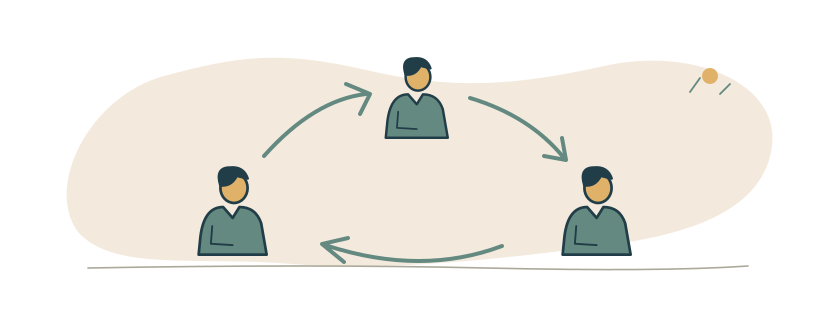
Validation loop. Guidon demonstrates a "squirrel" → Saltan pronounces a sentence → Guidon builds the next squirrel even more expensive. The prize is never finally awarded, because then the game is over.
Castration loop. Swan solves problems → Gwidon relaxes and regresses into a son → Swan takes on even more → sex in a couple dies quietly, because it becomes psychological incest.
Cinderella is the same Maiden, only with better PR
The plot is also international (type 510A, from the Chinese Ye Xian of the 9th century to Perrault and Grimm). Mechanics: status comes from outside, for beauty and patience, as a result of one point. Work is not provided - it is provided to be noticed. In the office, it sounds like "I'm good, why don't I get elected." And the classic finale of such an installation: the carriage does arrive, but at twelve o'clock everything returns, because someone else's magic does not make us a subject.
Puss in Boots is the Swan in its purest form
The best illustration of hyperfunctional. The cat does absolutely everything: invents a title, arranges a meeting with the king, intimidates the villagers, eliminates the cannibals. The owner does nothing - and that is why in the finale he gets a castle, a princess and a lifelong addiction to a cat. Anyone who "pulls" a partner or an adult child should reread this tale from this point of view: everything worked out, and that's the problem.
The Little Lame Duck: the cost of impatience
A Ukrainian story in which a miracle lives in a house until they try to appropriate and fix it. Grandfather and grandmother should hide the clothes and the duck will fly away. A very accurate metaphor for Saltans of all stripes: what is held by force is the first to go.
The golden squirrel: how showing off can hurt a business
The most valuable detail of the fairy tale is the squirrel. Not a kingdom, not heroes, but an attribute: nuts with a golden shell, emerald kernels, a song under the supervision of a deacon. A piece created specifically to tell the father about it. In the modern translation - a custom wheelbarrow on credit, a conference where you are a speaker, a reel from a co-working space in Bali, a "founder" business card at zero turnover.
And here science throws up something completely unpleasant. Peter Gollwitzer and colleagues showed in 2009 in Psychological Science that when a person declares an identity-related intention ("I'm going to be a lawyer", "I'm starting a business") to the environment, and the environment notices this, they subsequently work less hard on this goal than those who remain silent. Public recognition gives a "premature sense of completion": the symbol of identity is obtained, the psyche considers the task partially closed. The effect is stronger in those who are most devoted to the goal. In short: he told - consider, he has not done half of it.
Success is when you go from failure to failure without losing your enthusiasm.
- a phrase traditionally attributed to Winston Churchill (there is no documentary evidence that he uttered it - but it is still more useful to the Guidons than any motivational reel)
The second scientific support is the theory of self-determination by Desi and Ryan. She distinguishes between autonomous motivation ("I do it because it's mine") and controlled ("I do it to be approved / not to be ashamed"). Decades of research show that controlled motivation produces worse results and leads to burnout faster. Gwydon works almost exclusively on the controlled—he's building a kingdom not because he wants a kingdom, but because he wants Daddy to come. Therefore, each subsequent project must be even louder, and burnout does not come in opposition to success, but as a result of its mechanics.
Stories from the consulting room
The cases are depersonalized and composed of several stories: the details are changed beyond recognition, the mechanisms are real.
The first case: Guidon, who sold for millions and lay down on the sofa
An entrepreneur, a little over twenty-five. Two years ago - record sales, negotiations with investors, creatives by own hand, because the designer did not suit, buffets, three projects in parallel. A year later, he lies down and cannot get up. The request at the first meeting: "I want to be who I was two years ago."
I asked one question: "Do you want to go back to that particular guy — or his numbers, but without his ending?" Then we calculated the current workload: half a hundred orders per day, launching a branch in two weeks, scripts, CRM. “Is it half the productivity? Then what do you compare it to?” It turned out — with a peak that ended with a fall. The main work wasn't about time management (he stacks up better than me) - it was about the question of "whose wishes am I fulfilling and what will happen if I stop." In three months — not a sales record, but the first vacation in years without a laptop and the decision to close one of the three projects. He called it "finally I chose, not I was chosen."
Case two: grandson, son and "held by the hand"
The guy, almost thirty, lives abroad. Complaint - "I don't want anything", career paralysis, devaluation of everything that is possible. We dig up three generations: the grandfather measured his father by external benchmarks, the father gave his son feedback exclusively in the format "it's okay, but", and the son now measures himself by classmates from Facebook. The classic ancestral relay of the Saltans.
The key phrase of the session came out by chance: "No one ever took my hand and said - take a risk, I'm there." This was the deficit around which the entire structure revolved. It wasn't motivation that was lacking, it was a safety net. Next, we did not "increase motivation", but built support: very small actions with fixation of the result, separate work with anticipatory devaluation ("I will not want - I will not be disappointed") and an honest conversation about the fact that recognition will never be received from a figure who is structurally unable to give it. A few months later, he did something he had never done before: he staked a claim to the position without waiting to be noticed. They took
Case three: Cinderella after the third carriage
A woman in her thirties, the two previous stories are destructive and treacherous, the third has just begun, and the main fear is "I will ruin everything myself with my anxiety." Here is the Virgin scenario in its purest form: waiting for a prince to come and appoint a queen, and then a collapse when reality demands mutual obligations.
The work was demonstrably uninteresting and that is why it was effective: first, physical resources (she worked to exhaustion and had a "window of tolerance" as wide as a needle), then - the separation of two things that stuck together: where are the real alarm bells in the partner, and where is the projection of two previous stories. Six months later, she formulated herself: "I stopped waiting to be elected. Now I choose too." This, in fact, is a way out of the role of Cinderella: the carriage does not arrive - the carriage is hired.
Case four: Saltan and Guidon in one pair
A couple of men, together for more than ten years, the difference in age is noticeable. Senior - all administration: documents, taxes, planning, joint business. Younger - creativity, mood, music "for the soul". Acquaintances when the younger man was eighteen: he actually grew up in this relationship. The conflict entered the office like this: "Everything is fine with us, it's just that I can't agree on a job with him - and they say I have a magpie crisis."
In fact, the younger one, already well into his thirties, was going through a belated separation: sabotaging tasks like a teenager, and then copying the mentor's tone ("do you understand? are you sure?") - a crooked but sincere attempt to prove maturity. The elder, in turn, was talking to a man in the director's register with an intern - and sincerely did not understand why the answer was "who are you, father?".
The main intervention was boringly technical — the sculpting of scales: separate conversation between business partners, separately — a conversation between husband and wife, and no mixing. Plus a simple rule for the elder: said once, reminded the second - and let go; then you show with an example. In a few months, the number of quarrels fell by more than half, and the younger one for the first time brought the completed task himself - not because he was forced, but because there was no one to fight with. Guess whose ears were sticking out of that fight. That's right: not the partner's, but the parent's.
Case five: three diplomas that no one asked for
request Husband V., in his early twenties. "I think I'm burning out. I sit at my work laptop and do nothing - and it scares me." A year before that, he completed the career distance that usually takes three to four years in his company, and became the youngest in his position.
What turned out to be deeper. Formally, the crisis began after the salary revision: efforts ceased to be converted into money linearly, and motivation fell. But there was something else nearby: parallel studies at several master's degrees at once, one of which he chose under gentle pressure from his family; one and a half dozen hours a week in the game; noticeably gained weight in a year; and the phrase, said in passing: "my whole life is waiting until I finally get there."
Clarification of the real problem. The key was not the power of procrastination, but its selectivity. He impeccably covered everything that was accountable - what management sees - and did not do exactly what no one measures: strategic tasks and own projects. That is, the fuel ran out exactly where there is no viewer. It is not a lack of discipline. This is a diagnostic marker: a person has worked for years for demonstration, not for the result, and now, when there is no one and nothing to demonstrate, the system has become.
Scenario. The same island with squirrels. A family of specialists, the reputation of "all of us are excellent", no grade below the highest. Three diplomas are squirrels with emeralds: symbols of choice, collected for the evaluator. The worst thing is that the parents have been satisfied for a long time: they directly say that a lot has been done for his age. And he can't stop because Saltan has moved inside. Now he is competing not with his parents, but with his own children's plan ("to be a co-owner at twenty-five"), and this rival, unlike his parents, will never say "enough."
Methodology and practices. Inventory of squirrels with the specific name of the appraiser opposite each. Autonomous motivation test every morning. A silent start for a new project. Scaling scales: hiring is not a sentence, but paid access to someone else's business model, from which you must take the maximum before exiting. And separately - the legalization of rest: the game stopped being called procrastination and became a dosed resource, because cutting off the only source of pleasure for a person who already has two of them is the fastest way to make things worse.
Result. First, it's boringly technical: take the work chat to a separate screen to see the flow of messages without switching between devices, and make an external to-do list instead of keeping it in your head. By his own estimation, this relieved most of the background stress—and it's worth stopping there, because we spent weeks looking for the "deep cause," and half the tension was removed by rearranging the window. Next is a return to one's own project with a partner and an honest plan: make it to the fall, close the diplomas, and leave without a tarnished reputation. He still thinks he's moving slowly. But for the first time he is moving where he chose.
Exercises: stepping off the ship bound for your father
Inventory of proteins. Write down everything you have done in the last year "for show". Now opposite each point is the specific name of the person to whom it was shown. If the same person (or an internal copy) appears in the list over and over again, congratulations, you have found Saltan.
Silent start. The next project is two weeks without announcements. No hiccups, no "and I'm starting it here." Gollwitzer in direct text: the stated intention partially disables the need to carry it out. Make it a goal to be hungry.
Autonomous motivation test. One question every morning before the main task of the day: "If no one ever found out about it - would I do it?" A week of such answers gives a more accurate picture than a year of coaching.
To the Swans: one "figure it out yourself" per week. Not because of hardness, but because of mathematics: every problem you solve for your partner is his unacquired experience and a minus to your attractiveness. Hyperfunction of one always equals hypofunction of the other. Someone has to stop first.
Saltanam: one admission without a "but". The hardest exercise on the list. To say "you are well done" and to stop. Do not add "but I would do it differently". Those who were not told this phrase without a tail in childhood, then build islands with squirrels.
Sculpt the scales. If you and your partner are also business partners, start a literal switching ritual: a separate time, a separate place, a separate tone. The sentence "now we speak as business partners" is worth three seconds and saves weeks of silence.
- Taking over
- One person has made the calls, filled in the forms and fixed everything. Nobody asked the other person.
- Offering support
- “Would you like a hand? What part would you like to do yourself?” Then wait for the answer.
The roles of "savior" and "servant" are clearly visible on the Spann-Fisher Codependency Scale, and the price of the whole show for the couple is shown by the CSI-16 Couple Test. Go through both, and the conversation about who's in what role will be more substantive.
Who can try this, and who needs support first
The practices above work if you recognize yourself in one of the roles and you have a resource: sleep, work, relationships more or less hold, and it is about the usual pursuit of recognition and chronic fatigue from it.
First, go to a specialist (and sometimes to a doctor) - if after another "island" it is not fatigue, but failure: weeks without energy, the satisfaction from everything has disappeared, sleep is disturbed, thoughts about senselessness. Burnout and depression present a similar picture, but require different actions, and self-diagnosis is costly here. It is also worth coming to the office if the pursuit has already cost money that you could not afford to lose - there is usually another mechanism besides ambition. I wrote about the neighboring scenario, where instead of squirrels there are claims and patience, in the article about passivity, aggression and assertiveness.
And the final detail, which I love the most in this fairy tale. Saltan did come. But he didn't come on a squirrel - he came when Gwidon stopped sending ships and just lived in his kingdom. Morality without pathos: the island is worth building for yourself. Then the guests will also tighten up - only it will not be so critical for you.
Sources: Gollwitzer P. M., Sheeran P., Michalski V., Seifert A. E. When Intentions Go Public: Does Social Reality Widen the Intention–Behavior Gap? Psychological Science, 20(5), 2009; Wicklund R., Gollwitzer P. Symbolic Self-Completion (1982); Deci E., Ryan R. Intrinsic Motivation and Self-Determination in Human Behavior (1985); Ryan R., Deci E. Self-Determination Theory (2017); Berne E. Games People Play (1964); Uther H.-J. The Types of International Folktales (ATU), types 707, 510A, 545B; Propp V. "Tale Morphology" (1928); Bettelheim B. The Uses of Enchantment (1976).
This article is for information and does not replace an individual consultation with a psychologist.
Original article↗